

Acceptance
It's a little harder, this Valentine's Day.


When Mike moved into a memory care facility, I knew we were both making a big transition—from living together (as we had since we were both 24 years old) to living in two different residences. But I didn’t quite understand how quickly we’d move toward living in two different worlds.
Each time I visit Mike, it’s clear that he has moved a little farther away from the world I inhabit, the world that keeps on turning right outside the secure doors of his memory care neighborhood. His apartment has a window looking out on the secure courtyard accessible only via his community; I thought he’d enjoy being able to see the outdoors and sit on the small deck once in a while, when the weather was pleasant enough. He’d always liked sitting on our covered back patio, watching the birds and squirrels in our yard. Knowing he still had a version of that option might, I hoped, make him feel a little more at home.
But as far as I can tell, Mike isn’t aware that outdoors exists anymore. His facility works hard to prioritize their residents’ autonomy, whenever possible, giving them options rather than directions. Even though his profile sheet tells the staff he enjoys sitting outdoors, they ask his preference instead of making that choice on his behalf: Would you like to go sit outside on the deck for a while?
If he can’t provide a clear response to that question, he stays where he is. They offer a different option.
To my knowledge, Mike has never once set foot on that deck.
I’m feeling the loss of my partner acutely this week, in the lead-up to Valentine’s Day—which is odd, since this isn’t a holiday we ever paid much attention to (or, at least, not beyond the first few years of our relationship.) I told my friends that one of the many reasons I loved Mike was that I knew for certain he would never bring home a mass-produced teddy bear clutching a satin heart that said I love you and think that actually meant something.
Instead, he’d bring home my favorite chocolate bar when he made a random trip to the grocery store. And that did mean something: it meant he was thinking about me all the time, and in particular.
A few days ago, casting about for something to watch on Netflix, I skipped over one rom-com after another. I zipped right past the new season of Bridgerton. I told myself I was waiting for the second half of the new season to drop, so I could watch the whole thing at once—but I don’t think that’s actually true. Even a cheesy historical romance that bears no resemblance to my life is just too much to endure.
I really believed I was in the acceptance stage of grief when I placed Mike in memory care, situating our lives on two distinct paths. I was facing the facts, doing what had to be done. But this week I’m back to depression, feeling a deep sadness when I consider what I’ve lost—not just the physical presence of my partner, but his quick wit. His generous spirit. His thoughtfulness, always aimed at telling me I was known and loved.
I have to remind myself that the famous Kübler-Ross stages of grief were never meant to be understood as linear, or even broadly pertaining to grief at large. They were meant to be descriptive of the feelings people cycle through as they grieve—and, more specifically, the feelings of people facing a terminal diagnosis. Those stages aren’t meant to outline a process every grieving person follows.
My own experience is that dealing with grief is like running laps. Even as I keep moving forward, there’s a good chance I’ll end up right back where I’ve been before: sad, angry, insistent that there’s something I can do to make things better.
So I know that spending a little time in the depressed Stage 4 of grief doesn’t actually mean I’ve moved away from the acceptance of Stage 5. In fact, I have fully accepted that—as a friend said to me some time ago—this is never not going to suck.
Another friend sent me a pair of Valentine’s Day socks this week, a little surprise I discovered when I picked up the mail.
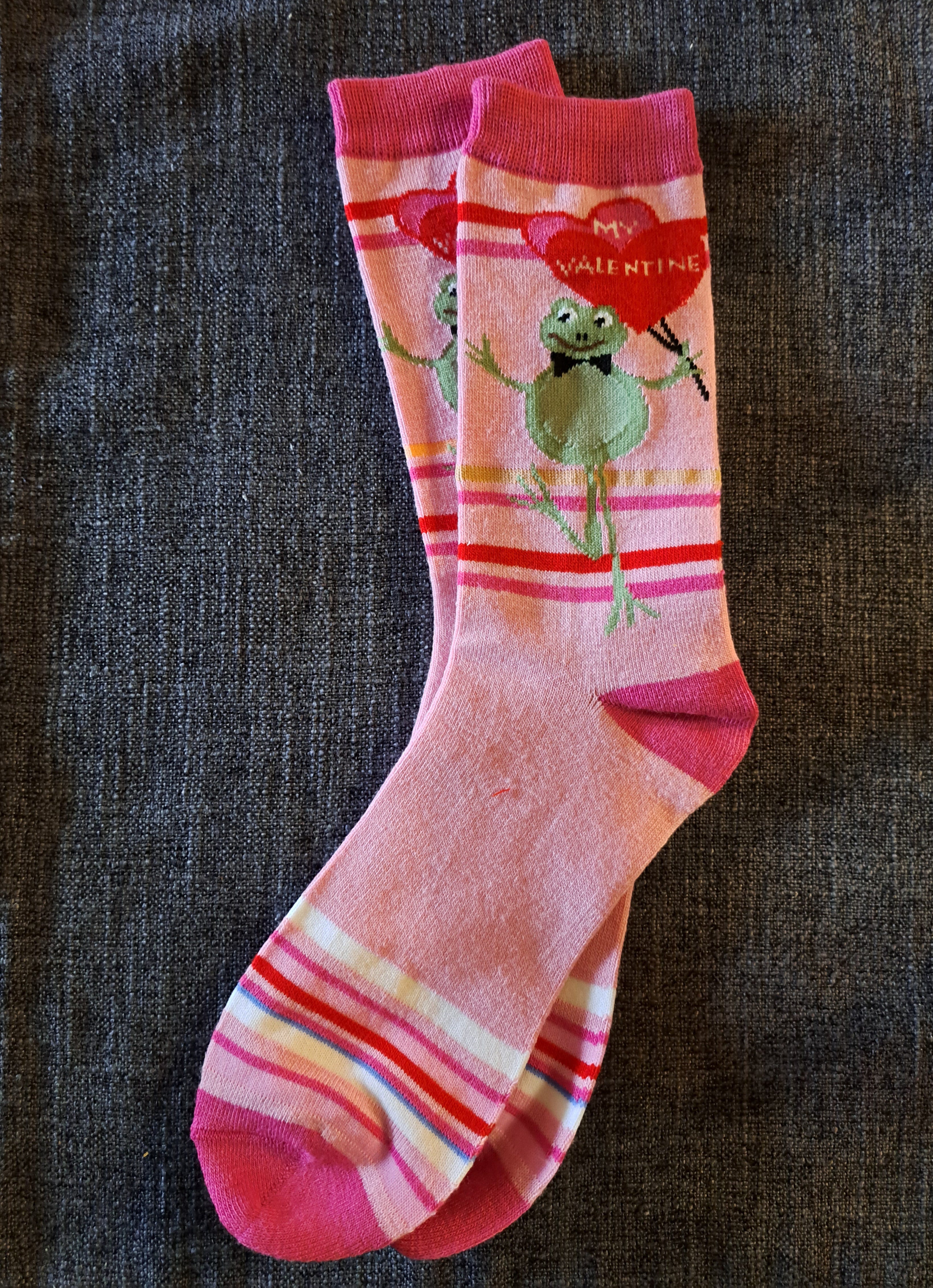
I texted to thank her. “Holidays are hard,” she replied. “Happy I could surprise you with this.”
My friend lost her own partner after many years of caregiving; she knows how rough the road can be as we stumble among the stages of grief. I’ve mostly given up on bargaining (I know there is no deal to be made that will undo the damage already done to Mike’s brain), but I still find myself wrestling with anger and sorrow.
Last week, the nursing director at Mike’s facility suggested having him evaluated for hospice. If he’s accepted into a hospice service, that will add another set of helpers to the team supporting him in memory care. It’s not a concession to any particular set of facts, the director assured me—just an extra layer of support on this leg of the journey, for Mike and me.
I know there are people in denial of the fact that dementia is a terminal diagnosis. (These are the people who point out that Grandpa Joe lived to be 85, even though he had Alzheimer’s—as though this somehow negates the fact that Alzheimer’s was, in the end, his undoing.) The nursing director was trying her hardest to tiptoe around this fact. I’m sure she’s had a lot of practice with avoiding a reflexive no.
But I wasn’t resistant at all: I asked her to go ahead and schedule an evaluation as soon as possible. I’m in no hurry to say goodbye, but accepting what’s happening to Mike—and accepting all the help available to him—is one of the few remaining ways I can still show him how well he is known and loved.
Finally. Someone who has the same
Struggles I have been having. Thank you for posting this. It was helpful to me.
Grief. As they fade away, you face the loss of who they used to be. I agree with your point of view, “it’s never going to not suck.” Do something nice for yourself. 💜